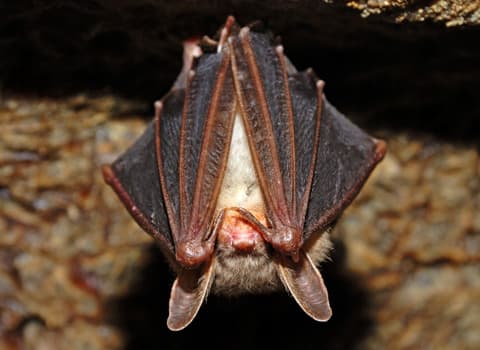
Little brown bats have silky, dark brown hair, often compared to the color of cinnamon. They have pale gray coloring underneath, and their hand-like wings are black. We are often asked if bats make noise, and they do; however, people cannot usually hear it. They make sounds by echolocation, which are too high-pitched for our ears. You may hear a click or squeak as they fly right overhead.
Although bats are beneficial to our environment, they are like any other animal and will defend themselves if provoked or threatened. Unfortunately, a bat bite can be very serious as they are known carriers of rabies. Histoplasmosis is another health risk associated with bats and is a fungus that lives in soil enriched by bat droppings or guano; when airborne spores are inhaled, it can produce flu-like symptoms but can also be more severe. An accumulation of bat droppings can also contaminate attic insulation and other building materials. For these reasons, you should contact Thomas Pest Services right away if you notice a bat in the house.
Why do I have a bat problem?
Small holes, gaps, and openings on the exterior of a structure will welcome these opportunistic pests, and once inside, they’ll have no reason to leave unless forced.
How do you get rid of bats?
At Thomas Pest Services, we offer comprehensive bat control services in Albany and throughout our service area, taking care of bats from start to finish. Our bat removal process includes:
A thorough inspection to locate the colony of bats and to find entry points.
Humane removal of the bats
Sealing of areas where bats are making their way inside (openings ¼ of an inch and larger).
Sanitization of areas where guano is located to prevent Histoplasmosis.
Contact Thomas Pest Services if you need help getting rid of bats. In addition to providing bat removal services, our team of wildlife control professionals can also handle raccoons, skunks, and other nuisance wildlife common in Upstate New York.
Bat prevention tips
To prevent bats from entering your home or structure, you should:
Seal any openings on the exterior of the dwelling that would allow bats to enter.
Consider installing a bat house(s) on your property to entice these pests away from your home.
Repair any loose shingles or fascia boards.
Cap chimneys and install mesh covers over vents.
If you’ve discovered a bat in the house or on the exterior of the house, and are concerned you may have a colony of bats roosting in your attic or elsewhere, contact the bat control experts at Thomas Pest Services.
FAQ
Most common bat questions
How do I know if bats are living in my attic?
Many homeowners do not see bats inside their homes but may notice signs of activity around their attic or roofline.
Common signs of bats in an attic include:
· Seeing bats enter or exit your roofline around sunset
· Hearing scratching, squeaking, or rustling sounds
· Finding bat droppings (guano) near entry points or below roosting areas
· Noticing staining around gaps, vents, or siding
· Detecting a strong odor from accumulated droppings
Because bats are most active at night, visual confirmation is not always easy. A professional inspection can help determine whether bats are present and where they are enterin
What time do bats leave the attic?
Bats typically leave their roosts around dusk to search for food.
During warmer months, homeowners may notice bats emerging from attics, rooflines, chimneys, or other openings shortly after sunset. This is often the best time for professionals to observe activity and identify entry points.
Why are bats flying around my house at night?
Seeing bats flying around your home at night is usually a sign that there are good feeding opportunities nearby.
Bats are attracted to areas with:
· Abundant insects
· Water sources
· Trees or wooded areas
· Safe places to roost during the day
Bats flying near your home does not always mean they are living inside, but repeated activity around rooflines or openings may indicate a nearby roost.
Can bats get through small holes?
Yes.
Bats can squeeze through surprisingly small openings. Some species can enter gaps as small as approximately 3/8 of an inch.
Common entry points include:
· Roofline gaps
· Damaged soffits
· Loose fascia boards
· Roof vents
· Chimneys
· Gaps around siding
· Utility penetrations
Because bats can access areas that are difficult to see, a thorough inspection is important before sealing openings.
Do bats come back after exclusion?
When bat exclusion is performed correctly, bats should not be able to return to the same entry points.
However, prevention depends on properly identifying and sealing all potential access areas. A professional exclusion service focuses on:
· Allowing bats to safely exit
· Sealing secondary openings
· Protecting vulnerable areas
· Preventing future entry
Are bats common in New York homes?
Yes. Several bat species live throughout New York and may occasionally enter homes looking for safe roosting locations.
Homes near wooded areas, farms, lakes, rivers, or properties with mature trees may be more likely to experience bat activity.
Bats often become a concern when they move into:
· Attics
· Roof spaces
· Chimneys
· Wall voids
· Other enclosed areas
How much does bat removal cost?
The cost of bat removal depends on several factors, including:
· The location of entry points
· The complexity of the home
· The amount of exclusion work needed
· Repairs required to prevent future access
Because every home is different, a professional inspection is the best way to determine the appropriate solution and provide an accurate estimate.
Can I remove bats from my attic myself?
DIY bat removal is not recommended.
Improper removal attempts can:
· Trap bats inside the home
· Separate mothers from young bats
· Leave entry points unsealed
· Create additional problems
Professional bat exclusion ensures bats are removed safely while protecting the home from future activity.
What should I do if I find bat droppings in my attic?
Avoid disturbing large amounts of bat droppings or attempting cleanup without proper protection.
Bat guano can create health concerns when accumulated in enclosed areas. A professional can evaluate the situation, determine whether bats are still present, and recommend the safest next steps.
How can I tell if I have bats or another wildlife problem?
Different wildlife species leave different signs.
For example:
Bats
· Flying activity at dusk
· Guano below roosting areas
· Entry points near rooflines
Squirrels
· Daytime activity
· Chewing damage
· Scratching sounds during daylight hours
Raccoons
· Larger noises at night
· Damaged vents or roof areas
Correct identification is important because each wildlife issue requires a different solution.
Can bats be removed from my home at any time of year in New York?
No. Bat exclusion cannot always be performed year-round.
In New York, timing is important because many bat species form maternity colonies during the summer months. During this time, young bats are born and remain dependent on their mothers until they are old enough to fly.
If bats are excluded too early, adult bats may leave while young bats remain trapped inside the structure, creating a serious welfare concern and potentially leaving homeowners with additional problems.
Professional bat exclusion should be timed around bat life cycles and New York regulations to ensure the process is safe, effective, and humane.
A wildlife professional can inspect your home, identify the species involved, and recommend the appropriate timing and solution.
When is the best time of year for bat exclusion in New York?
Bat exclusion timing is extremely important in New York because of bat maternity season.
Many bat species give birth in late spring and summer, and young bats may not be able to fly immediately after birth. Because of this, exclusion work is typically avoided during periods when flightless young bats could be left behind.
The ideal timing depends on:
· The species of bat
· The location of the colony
· The time of year
· Current New York regulations
· The condition of the home
A professional inspection can determine whether exclusion is appropriate immediately or if a scheduled exclusion date is recommended.
Request Your Free Estimate
Ready to take the first step? Request a free estimate and let us tailor a pest control plan just for you.
For Expedited Service Call (518) 861-4921
Reviews
See what our satisfied customers are saying about our exceptional pest control services. Explore reviews for peace of mind and confidence in choosing Thomas Pest Services.